
Specification
- Year: 1960-1961
- Make: Maserati
- Model: Tipo 60/61
- Engine: 4 cyl
- Disp: 2.0/2.9 liter
- Gears: 5 speed
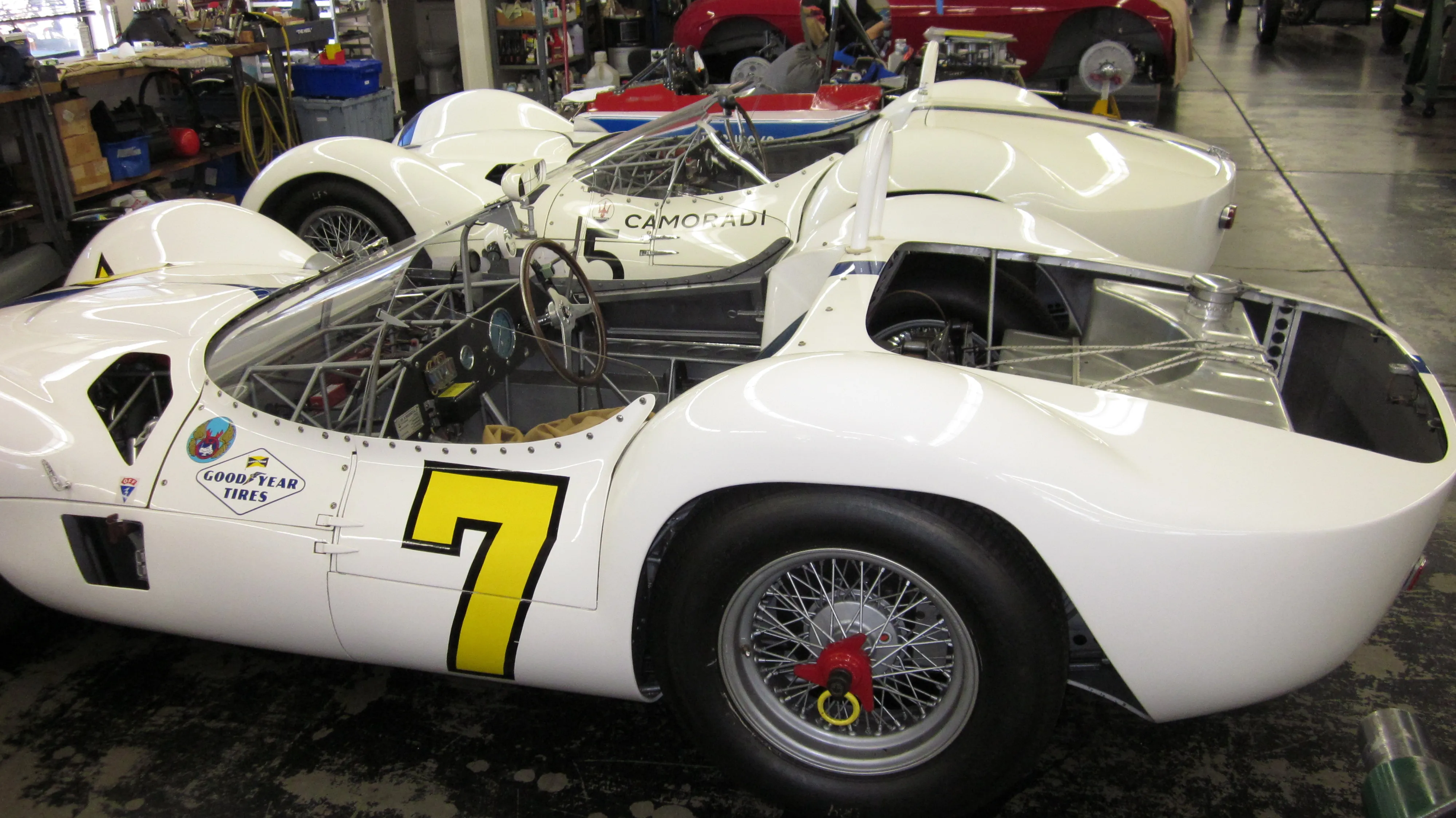
December 16, 2011: During the 9 years and change that I worked at the Corte Madera location of Phil Reilly & Co, I had the pleasure of working on four different Maserati Tipo 61 Birdcages. The two cars in today’s lead image were major players in the success of the model, racing with Team Camoradi USA in the 1960 World Sports Car Championship, as well as at other FIA, USAC and SCCA events in ‘60 and ‘61.
A New Car for the Privateers
One of the last successful front-engine racing sports cars before the mid-engine revolution, the Tipo 60 was introduced in late 1959 with a two liter four cylinder engine, increased to 2.9 liters for the American-market Tipo 61.
Maserati had been through a period of financial distress, pulling the factory team out of international racing after their 1957 World Championship with Juan Manuel Fangio in the 250F. But by late ’58 they were already prepared to develop a new car for customer teams, and the Tipo 60 was that sports car.
The motor was based on the version in the previous 200SI, which had a more conventional large tube frame design. The Birdcage was unique because it ditched the big oval-tubes, replacing them with hundreds of short sections of 15, 10 and 8 millimeter tubes. Reported numbers vary, but the bare frame certainly weighed less than 80 pounds (36 kilos).

A beautiful scale model of the chassis for 2458 
The Birdcage’s predecessor, the 200SI. Huge drum brakes and classic lines, but obsolete by 1960. 
This interior shot of a 200SI shows the large tube frame members that were typical prior to the Birdcage 
The Maserati 200SI engine was the base that the Tipo 60 version was developed from. Look how much room there is around the engine!
It has been said that the chief engineer at Maserati, Giulio Alfieri, wanted to build a monocoque chassis, which Jaguar had pioneered in 1954 with the D-type. Historians claim that Italy didn’t have the required expertise to build such a chassis, but I think it is fairer to say that Maserati lacked the resources to do so. What they did have was a team of highly skilled welders, and Alfieri essentially created a monocoque chassis using small tubes instead of sheet metal, each group of tubes welded into a plane that served as one face of a box structure.
Beyond the creation of a new type of light and stiff chassis, the Tipo 60 was designed to have as small a frontal area as possible and so the engine was canted over at a 45 degree angle, the hood line so low that the fenders bulged high above it. With an ungainly hump to cover the dual side-draft Webers, the shape of the car was not well-loved at the time.

Features under the skin that made the Birdcage stand out were the disc brakes, made in-house under license from Girling, precise steering from the magnesium-cased rack and pinion, and a 5 speed transaxle with de Dion tube rear suspension for weight distribution, lighter unsprung weight and lower polar moment.
Inside the Maserati Tipo 61 Birdcage
I was deeply immersed in major overhauls of the two cars displayed above, chassis 2458 and 2461. The latter is the number five Camoradi car, the first Birdcage that I was introduced to in 2006. It had recently found a new owner and came to Reilly’s for a freshening of all the systems. The chassis was gone through, the engine rebuilt, and the transaxle overhauled.
That particular car had an aluminum case for its gearbox rather than magnesium, which was the material used in the other T61’s that I cared for. There was speculation that it was a 250F Grand Prix box, from which the design of the Birdcage transaxle had its origin. Apart from minor details, the internal components were of the same design. Crosthwaite and Gardiner, who supply the world with many of the parts to preserve these cars, lists the same main cases for both the 250F and the T61.
I have also read, however, that Alfieri redesigned the T61 gearbox internals to save weight, since the initial two liter engine would have placed less load on the parts than the six cylinder 250F’s highly developed GP engine. I have not had the opportunity to work on a 250F, so what is the real history?

It takes special care and close attention to detail to keep these gearboxes going. Just look at the list of DNFs from back in the day due to broken transaxles… Sebring 1960 for example, as discussed a little later. 2461 was originally entered in that race for Stirling Moss and Dan Gurney, but blew the engine in practice after only a few laps, chucking a rod out the side of the block. Not a great start with Team Camoradi.
A Big Win at the ‘Ring
Later in the season, she redeemed herself with a win at the 1000 km event at the Nürburgring, with Moss and Gurney finally behind the wheel. It was a rare endurance event win for the fragile cars, though it almost didn’t happen after an oil line got loose and hosed Gurney with hot 40 weight. The team was able to repair it without losing too much time and the ace driving team reclaimed the lead.


This was not an isolated incident; the oil plumbing caused numerous problems throughout the car’s competitive life. The pump is able to generate very high pressure when the oil is cold, high enough to break things, so care must be taken to warm the engine before using any real revs. There are simply a lot of hose and pipe joints to stay on top of too.
Jo Bonnier drove this car to second place at the Grand Prix of Sweden in August of ‘60, beaten to the line by 2461’s last winning driver, Stirling Moss, in a mid-engined Lotus 19. The days of the front engine car were coming to an end, even as Maserati refined the type.
Remarkably, this car spent the next two years of its life racing with a Ferrari V-12 crammed under the hood. I know how tightly the 4 cylinder Maserati fits between the top two frame tubes, and I can barely imagine how a V-12 was made to fit. But plenty of Birdcages ended up with American V-8’s not long after their debut seasons.
2461 was reliable as a hammer when it ran at the Monterey Historics from 2006 onward. We did have an embarrassing oil leak the first time out, the split rear main seal needing a second shot at sealing the ends. Unfortunately, that means taking out the motor, which is an all-day proposition with the T61. Just removing all the interior panels and heat shields takes forever. You cannot expect to ever do a quick clutch replacement on a Birdcage.
This seal type uses a removable spring so that it can be opened at the split and slipped over the crank. Then the spring is carefully refitted into its groove and the split ends cleaned before applying a dab of RTV to glue it up. I’ve seen these go wrong on more than one installation in different cars over the years.

The split rear lip seal for the T61 crankshaft. Note the removable tension spring back in its groove. 
The Birdcage rear main. Note the broken stud which secures the back of the sump, a common failure. Also, a badly worn ring gear on an original-type flywheel. 
The Birdcage crankcase with 5 main bearings and four studs per cap. 
Birdcage pistons and rods. Big – Short – Stout
A Birdcage Wins at The Cuban GP
The second T61 in my roster was the one that I spent the most time with, number 2458, Camoradi car number seven, the winner of the 1960 Cuban GP with Stirling Moss, and of the LA Times GP at Riverside with Carroll Shelby.
Moss had already given the new Maserati its first big win at Rouen, France with the two liter Tipo 60 prototype months earlier. The Gran Premio Libertad or “Freedom Grand Prix” was run under the new communist government of Fidel Castro, eager to retain the impression that Cuba was still open to foreign tourism. The competition was not particularly stiff, with only three cars finishing on the lead lap. Pedro Rodriguez finished second, over a minute behind in the NART Ferrari 250TR and Masten Gregory third in the Camoradi Porsche 718 RSK. The Birdcage was a very fast car.

I learned quite a lot about Type 61 transaxles in my time with this car, as we had a number of issues between 2008 and 2015. But it wasn’t the first time this car had problems with the gearbox.
Trouble at the first Endurance Event
It was one of three Camoradi team cars entered at the 12 Hours of Sebring in 1960, driven by Moss and Dan Gurney and they were leading the race with a large margin until 136 laps when the ring and pinion failed.
In total there were five Birdcages entered at Sebring in 1960, and none of them finished. The entry for Masten Gregory and Carroll Shelby broke the engine on the second lap, dropping a cylinder liner. Briggs Cunningham’s entry for Walt Hansgen and Eddie Crawford, chassis 2459, also broke the gearbox, getting 149 laps out of it to Moss and Gurney’s 136.
The final Tipo 61 entry was chassis 2457, driven by Dave Causey and Luke Stear, which made it the farthest, until it broke another part inside the gearbox, reportedly a shift fork.
More Birdcage transaxle details are in a recent article that dives into the guts of these five speed paradoxes: The Maserati Birdcage Gearbox, Part One: The Tipo 61 transaxle’s origins and mechanical layout
The Harrison Car
Chassis number 2467 car was finished at the factory in the middle of 1960 and delivered to Frank Harrison, a Tennessean team owner running various sports cars in that period. Jim Hall, Carroll Shelby and Jim Jeffords drove this car in SCCA and USAC events.
They were leading the 1960 Road America 500 at Elkhart Lake, WI when something went wrong, a common element in the story of most Birdcages. As recorded in the definitive Birdcage reference, “The Magnificent Front-Engined Birdcages” by Willem Oosthoek and Michel Bollée:
After Jim took over at the first pit stop, he was back in the pits within a few laps. He got out and poured a bucket of water over his feet. I said, “Jim what the hell are you doing?” He said, “You drive it!” I just jumped back in the car and the moment I hit the brake, I knew we had a problem. The exhaust manifold had cracked and it threw fire right at the pedals. Flames were coming out!
Jim Jeffords, from The Magnificent Front-engined Birdcages, Oosthoek & Bollée
This was a frequent problem for the Birdcage, and 2467 was brand new at that race, coming straight from the factory. It was not a worn out old exhaust system. The sand-bent, gas-welded header was highly stressed and frequently leaned on the frame tubes that it snaked through. The heavy collector box/resonator was violently shaken by the pulses from the big 100 mm pistons and more than one broke its rubber hangers and left the car.
Shelby’s results in this car at the Laguna Seca Pacific GP, 2nd overall behind Moss in that dang mid-engined Lotus, were enough to win him the 1960 USAC Road Racing Championship. He had won the Riverside GP in chassis 2458 and the Continental Divide 100 at Castle Rock, CO in the Meister Brauser Scarab.
If USAC had a manufacturers championship, it would have gone to Maserati in 1960. The Birdcage won three out of five events on the schedule: at Riverside (Shelby), Road America (Jim Jeffords), and Riverside again (Bill Krause).
We took this car down the bare frame for a respray in fresh silver, keeping the yellow paint untouched. I went through the gearbox and suspension, while Ivan Zaremba prepared the engine.

Birdcage chassis 2467 being overhauled in 2011 
A look at 2467’s pedals, which would have been on fire that day at Road America 
The Birdcage’s exhaust pipes are squeezed through the cage in a tedious operation. 
The Birdcage pipes created a lot of heat for the driver’s feet even when not broken 
A dozen or so panels separate the engine from the Birdcage’s driver 
A close look at the rear halfshaft entering the wheel hub in the de dion tube outer end. 
Maserati T61 Birdcage rear end prior to fitting the transaxle
A Third Camoradi Maserati
The last Birdcage I was involved with at Reilly’s in Corte Madera was another Camoradi USA car, chassis 2464. This car’s big result in 1960 was its fifth place finish at the Nürburgring behind the Moss/Gurney entry, with Masten Gregory and Gino Munaron at the wheel. At the 24 Hours of Le Mans, it was running well with team owner Lucky Casner and Jim Jeffords driving, but a couple of starter motor problems with Camoradi’s other two Birdcage entries led them to preemptively swap the starter in 2464. That long pit stop put them out of contention and then Casner later put the car into a sandbank.
Motorsport Magazine’s race report claimed:
The second Camoradi Maserati driven by Casner/ Jeffords made a poor start, but gradually made up for this only to be delayed by a repetition of the leader’s starter motor trouble, only this time the fault was known in advance. Finally this car went off the road into the stupid sand banks the organisers insist on placing on some of the bends. Although extracted from the bank some of the sand got into the gearbox via the gear selector mechanism and everything eventually ground to a halt.
Denis Jenkinson, Motorsport, August 1960
I am dubious about this explanation for Casner’s exit from the race. A convenient excuse for another embarrassing gearbox failure? You see, the shift linkage enters the gearbox through a small casting that is mounted to the rear of the gearbox, low on the right side. The ones that I have seen have a thick rubber boot on the front and rear of the selector shaft where it passes through the casting.
Even if this one did not have a boot, or it was torn when it rammed into the sand bank, the part is held to the back of the gearbox by eight small nuts, and there is usually room to remove it without removing the fuel tank (which is secured with bungee cords in any event). So they should have been able to pop it off, clean out any sand and refit it in a short time. I suppose it is possible that sand got past the lip seal on the input pinion, and that would be another story altogether. A much more tedious job to pull the pinion housing, but also hard to imagine sand entering in that way.

A New Start Back in the USA
Back to 2014, the car had arrived with a new owner after a long period of historic racing in the UK, and we went through it to get it ready for American circuits, leaving it in its black livery. After I left Reilly’s in 2015 to start Traveling With Tools, they restored the car back to its original chassis and white Camoradi paint scheme. I’ve managed to lose my photos of the initial work on the car, but the RM Sothebys gallery of the last auction attempt in 2013 shows how it sat at the time.
In 2018 I went through the gearbox for Reilly’s in my new role as a freelancer, and I did some work on it later in 2023 at their new Penngrove location. A second gearbox overhaul and a bunch of chassis prep for a new season of racing.

Birdcage chassis 2464 gets freshened up in 2023. (I also did the engine for the A6 behind it, ten years prior.) 
Refitting the suspension to the car after crack checking everything. This car had a front spindle fail the test and got a new one from Steve Hart in the UK. 
A batch of Maserati T61 Parts for crack testing in the Magnaflux machine. 
The guide plates for the de Dion tube’s sliding block were heavily worn and got replaced 
Preparing to reassemble the gearbox after crack checking everything, 
Three different sets of notes on this ‘box from 2014, 2017 and 2023
There is much to be said about the engineering and design of these special cars. They gave me many moments of agony, but also joy and pride, when everything came together and another successful outing was concluded.
More details about the gearbox can be found in Part One of a two‑part feature, The Maserati Birdcage Gearbox, Part One: The T61 transaxle’s origins and mechanical layout
Part Two, covering failures and the work required to keep these units alive, will follow.
If you have enjoyed this look at one of the most interesting sports cars of the classic era, please sign up to get notifications when new articles come on line. Click the subscribe link below.
Leave a Reply