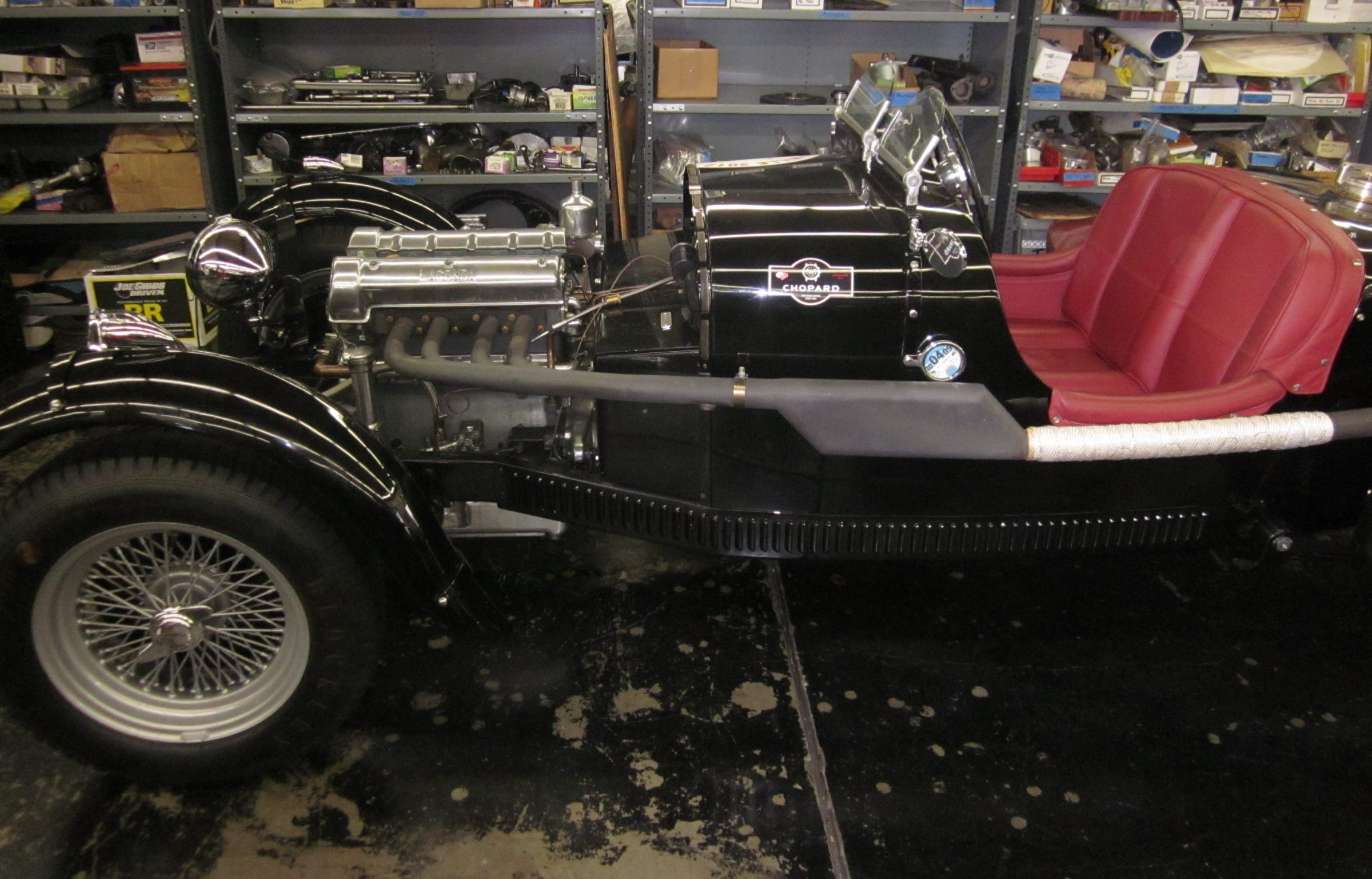

Specification
- Year: 1935
- Make: Lagonda
- Model: Rapier
- Engine: 4 cylinder
- Disp: 1100 cc
- Gears: 4 speed
Lagonda’s early history is complicated and it can be difficult to determine exactly why they decided to build the Rapier. The company’s founder had been gone for almost 15 years and the staff was regularly in flux until the company changed hands in 1935. It was then that W.O. Bentley quit Rolls Royce to take over Lagonda’s engineering department.
But by that time, the Rapier had already been conceived and produced, the engines outsourced to the Coventry Climax factory and the bodies to Abbott or other coachbuilders.
So what was the Rapier for?
The Great Depression put tremendous pressure on many manufacturers in 1929. A small company such as Lagonda, which had been doing quite well selling larger cars with a combination of luxury and speed, was suddenly placed in a difficult position. It appears that they were looking towards the lower cost market, but they did not have the cash on hand to develop a new car from scratch.
At the same time, a loyal group of Lagonda owners that had been racing with the marque’s two liter models, known as the PERR Syndicate, offered to partially fund a new model for the 1100cc racing class, for a cut of the proceeds if it were to be a success.
So circa 1933, the company went outside the factory to engineering consultant Ian Thomas “Tim” Ashcroft with a request to design a new small engine that would be the finest available from Britain or anywhere else. And the Rapier engine was the result.

DOHC and the Competition
Peugeot had pioneered the dual overhead cam layout in 1912 and by the early 1930’s the concept was becoming widespread at the highest levels of purebred racing engine design. Harry Miller followed Peugeot with dozens of wins at the Indy 500, with his engine and with Offenhauser’s later developments. Alfa Romeo, Bugatti and Maserati had twin cam engines by 1933, as did Sunbeam, Duesenberg and Stutz.
In the market that Lagonda was targeting, DOHC was almost totally unheard of. The Salmson S4 had a 1500 cc four with twin cams up top, but was a more expensive sedan. Riley and MG had purebred racers that fit the bill, but 750cc.

In addition to the basic DOHC architecture, the Rapier design also utilized another advanced concept for opening and closing the valves, the finger follower. It is unclear who first used them, with DeDion-Bouton and Isotta Fraschini being credited by different sources, but Bugatti was using them in the Type 18 in 1912, just after the short lived “banana tappet” period.
The finger follower is pivoted on one end and fits between the cam lobe and the valve stem on the other, dramatically reducing the reciprocating weight of the valve compared to bucket tappets. It also permits much more radical valve acceleration due to its geometry.
So the Rapier engine was a technically advanced, high revving and powerful design, totally alone in its class.
This Car and a Diagnosis
This 1935 model came into Phil Reilly & Co with a damaged engine, wearing decals from the recent 2012 California Mille.
The original supercharged variants of the Rapier used a Centric vane-type blower, and only a small number of units left the factory so equipped (in the post-restructuring era, when Ashcroft took over the production of his design).
This car had a Volumex unit fitted that was not exactly period correct, but a serviceable example of a Roots-type supercharger that might have have been available in the thirties.
The cams were already out before we pulled the engine from the car, so the initial assessment was underway before I laid hands on the project. What would I find inside?
It was immediately obvious that the cams and finger followers had suffered traumatic damage, with the cam lobes wearing deep gouges into the follower surfaces. Coming further apart, I found a threaded plug from an oil gallery, rolling around inside the head. The working theory was that this displaced plug made a large leak in the pressurized side of the oiling system, generating rapid wear.
When the bottom end came apart, the crankshaft and con rods had started to turn blue, which further pointed towards failing oil pressure as the primary fault. Fortunately, the driver shut it off before anything more catastrophic occurred.

The cams had destroyed several of the followers from lack of oil. 
The lost plug that made the oil go away. 
A cam lobe that was eating away at the finger follower. 
Another follower with less wear. 
One of the finger follower pivot shafts, with end plug and locating screw. 
The three main bearing crank was turning blue from heat, a result of low oil pressure 
The babbitt main bearings survived fairly well. 
The insert-style rod bearings in the modern Arrow rods were almost totally destroyed.
Paying Attention to Details
The engine’s oiling system had more than one issue that could have led to the damaged parts. The plumbing that sent oil to the supercharger had a large leak from the banjo bolt that fed the chain drive, as the threads had been pulled out of the casting. I assume that the lack of a spot face on the curved casting prevented the copper crush washers from sealing properly, and in an attempt to stop the bleeding, someone forced the fitting just a bit too far. Once it was pouring oil out instead of seeping, they crushed the feed pipe flat and wired the fitting in place, with globs of RTV to help staunch the flow. The blower’s oil return pipe to the sump had been cut and crimped off, I suppose to try and keep enough oil in the unit to keep it going.

The leaky oil fitting wired and glued into place, as it arrived in the shop 
Spot facing a flat for the washer to seal against 
The blower oil feel came from an adjustable port on the head; the pipe was smashed shut to slow the leak and keep the car on the road. 
The repaired circuit included reconnecting the return line to the sump.
The oil pump was already removed from the engine when I got my hands on it, and it was an unusual feature apart from the other issues the car had. The standard Rapier engine had a pump that lived in the sump, driven by a long driveshaft from the intake cam. For some reason, the previous builder of this engine had deleted that pump and replaced it with one mounted externally.
The pump was driven by a feature bolted to the front of the cam drive intermediate sprocket, which splits the chain drive from the gears below to the cams above. The drive coupling had substantial wear due to alignment issues and we made a new drive to improve that aspect.
The pressurized oil was sent via braided steel hose to the filter block on the side of the motor, which had been modified to take a modern spin-on filter. When I took that filter block apart, I found that the spin-on adapter had been made with the wrong dimensions, so that dirty oil was bypassing the filter and getting into the main galley feeding the bearings and the rest of the motor. So I spun up a new adapter piece that correctly sealed against the o-rings, to properly filter all of the oil.

The previous oil pump drive showing wear from misalignment 
The new pump drive in the center of the cylinder head 
The new mounting adapter for the oil pump (I did clean up that RTV splooge!) 
The adapted external oil pump 
The pressure hose to the filter block 
The filter block with an adapter spud that did not seal into the other half of the body 
The new, larger diameter adapter spud on the right
When reassembling the top end and checking how everything fit, I found that one of the cam carriers was leaning on the iron of the head casting before seating fully on its intended mating surface. That must have introduced a twist into the part that would introduce an unintended force, as well as changing the alignment of the finger follower.
In a similar vein, the underside of the cam cover conflicted with the cam oil rail, preventing the casting from seating properly and putting stress where it wasn’t intended.
The intake manifold was another area where there was a conflict between parts. Without the hose that connected the blower output to the intake, there was a hair’s breadth of space between the intake and the block. But not enough space to accommodate the hose and a hose clamp. I carefully filed the block to make clearance to assemble the parts properly.

The pencil points to a conflict where the follower pivot leaned on the head… resolved by filing a clearance relief on the aluminum part 
The intake cam cover needed work to clear the cam carrier 
Clearance mark inside the cam cover 
The intake was too close to the block and required some fettling to make room (the engine is on its side here).
Going Back Together
The bottom end of the motor went back together with new bearings, reusing the Arrow rods. The top end of the motor got new finger followers to go with cams refinished by Megacycle. I carefully assembled the finger shafts and oiling pipes to eliminate any gaps that would allow oil pressure to seep away, with red Loctite to prevent the assembly from falling to bits again. The oil is fed through the rocker pivot shafts, through the drilled finger followers to the surface of the follower. Above that, the oil pipes connecting the cam caps are drilled to shower oil onto the lobes as they spin. So there were intentional holes already leaking away pressure!

The new finger followers for the Rapier. Note the oil drilling in the face. 
The Rapier’s new followers showing how they transmit motion to the valve 
The drilled followers carry oil from the pivot shaft to the cam lobe 
The Rapier cam drive from below, showing the gear-to-chain arrangement 
The Rapier uses three chains to take the drive from the mid gear to the top 
The chain drive housing for the Rapier supercharger 
The blower is driven by chain and a Lovejoy coupler 
The Arrow rods after reconditioning, ready to go back in
Testing and Tuning
On the dyno at Paul Hasselgren’s shop in Berkeley, we did a fair amount of fiddling with the big 2″ S.U. carburetor to make it happy. Without a stack of alternate needles to test, I thinned the main needle a bit at a time to make it richer in increments until the mixture was correct. There is not much else to tune on an SU, other than changing the spring in the air slide to change the rate that it lifts at, which has an effect similar to an accelerator pump in a more sophisticated carb. Changing oil viscosity in the damper also affects this.

Changing the shape of the needle with a file allows more fuel to pass the jet that it fits into, enriching the mixture 
The big 2″ SU as used on Jaguars, with the air slide and spring 
The inlet side of the big SU after tuning on the dyno, Note the sharpie marks on the air slide, for evaluating how far it opens at full load
There was some question around the air valve’s opening and where it was, so I put sharpie marks on it and pointed the Go Pro at it for a couple of runs.
After the successful session on the dyno, the motor went back into the car and was re-tuned a bit for drivability. All the work I put into that needle to make it happy at full chat was not what it wanted on the road, and we swapped in a different version to make it happier.
Where is it now
Researching this particular project, I found that it was sold at Bonhams Audrain Concours Auction at Newport, Rhode Island in 2022. It fetched $140,000, which is a pretty good value, considering it came with receipts from this job (among other chassis work) for almost $60K! Most other Rapiers that have sold at auction in the last ten years have gone for less than $80K.
My career has had an enjoyable amount of variety, and this particular engine was one of those that has only come around once. I’ve been in a bit of a rut lately, with four Lotus Twin Cam engines last year.
If you have any questions about this build, or have some good Lagonda stories of your own, please share in the comments below!
Leave a Reply