One of the things that draws me to fly fishing is the consistently interesting topic of, “what are the fish eating today?” Sure, some people like bugs more than others, and maybe go a little too far down the rabbit hole. Some little boys that play with bugs grow up to be scientists, some grow up to be fly fishermen. I don’t know the Latin names of more than one or two insects, but I know Pteronarcys Californica, the giant salmonfly. It is an awesome bug and great fun to tie and fish with when the trout put on the feed bag for them, which is much harder to time than I’d like!
When I first started fly fishing in California in 2013, I really had no idea what I was doing and knew very little about the bug side of the game. So when I look through the old pictures and find a shot of a fat adult salmonfly from a trip to the Upper Sac, somewhere upstream of Dunsmuir, it’s wild that I didn’t recognize what I was looking at then, nor what it said about what flies I should have been fishing… I had thought that the salmonfly was a Montana bug, not knowing that California is right there in its name!

A Californian pteronarcys californica in 2014 
A shady spot on the upper Sac. 
The Fly Shop H2O rod and reel that I bought on this trip ten years ago and still use today. (The second one really, warrantied after I broke the tip in Florida casting to bass in the Tamiami Canal) 
A 17″ Upper Sac Rainbow! 
A Henrys Fork Salmonfly in Idaho, 2021 
This guy was fishing a bobber and nymphs while these huge bugs were flying!
Those early days of my fly expeditions all required long drives away from my home in Corte Madera, which is one of the reasons that I decided in 2014 to leave the state and become a nomad. Three hours of awful traffic to get past Sacramento and into the Sierra Nevada where the cold water rivers were. Or more than three hours north to get to the good waters above Lake Shasta… the Pit River, the McCloud, Hat Creek.
So now I’m a South Dakotan and I go to Idaho and Montana most every summer, but my current work project has me stuck in California again. I look at a photo or two of the Henry’s Fork in Idaho and I can’t wait to burn rubber eastbound across Nevada.

This year, I’m determined to be in Montana for July and August. The last two years, I’ve accepted gigs that put me at Laguna Seca in Monterey for half of August. Not this time, sorry!
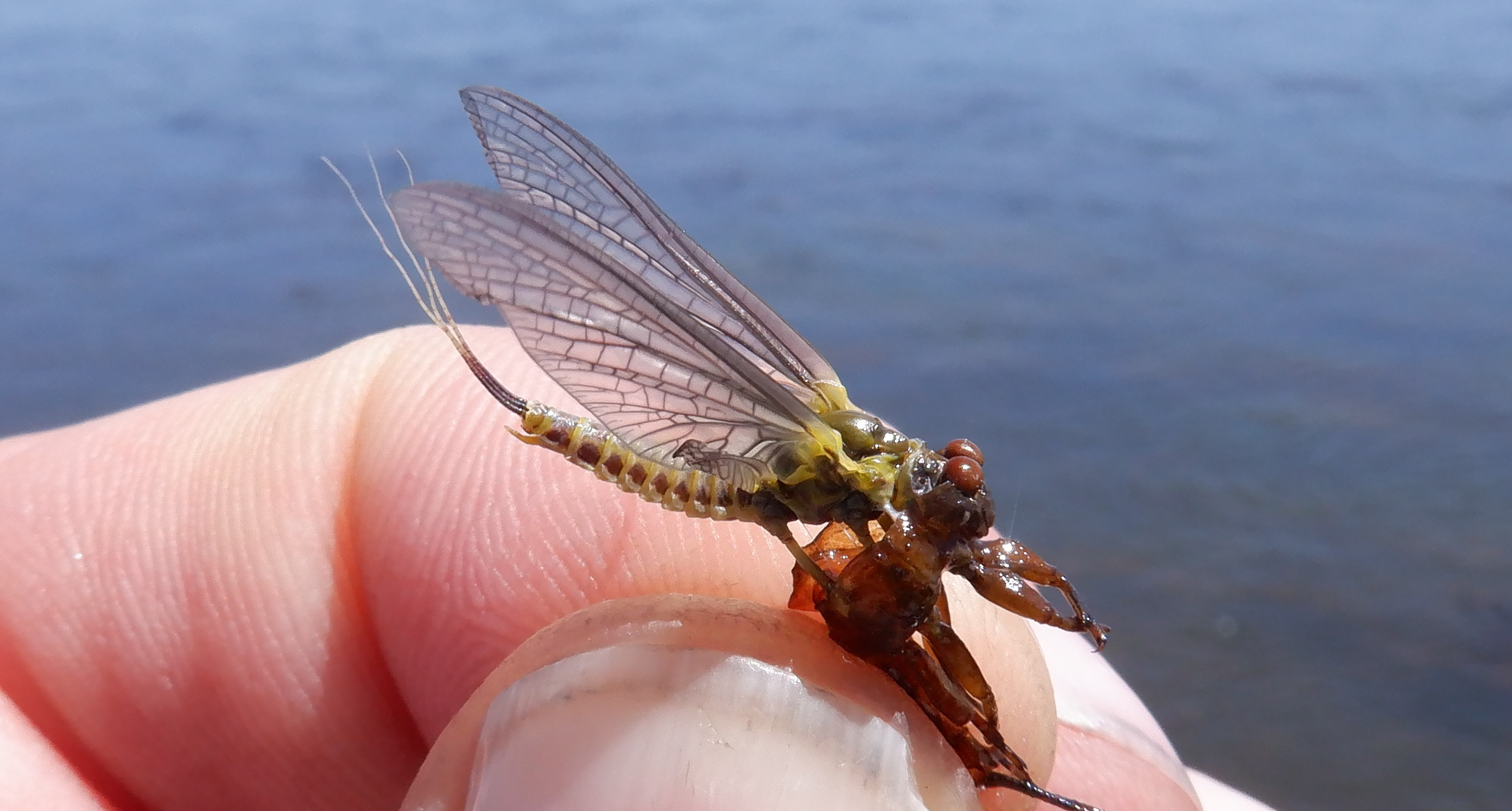
Two, maybe three mayflies are the focus of the mid-to-late Summer in the greater Yellowstone ecosystem, if you exclude the terrestrial insects, the crickets and grasshoppers and ants (and the stoneflies!). The green drake mayfly is first, and I’d need to be there by mid June to hit that hatch, which is my goal. I don’t know what it is about that bug that really does it for me, but part of it is that it is just a beautiful animal. In 2021, I scooped up a bug that was floating by me and the next few minutes of observation were astounding.
I had learned about “cripple” fly patterns, which mimic a mayfly that is stuck in its shuck, the exoskeleton that it needs to crawl out of in order to metamorphose from an aquatic nymph into a flying insect. People say that trout will focus on the cripples, because they are an easy meal. This particular bug struggled to escape its shuck while cradled in the palm of my hand.


A couple of times, I’ve been surprised to pick up a drake while sitting in a boat on a lake. This next pair of bugs came from Ennis and Hebgen lakes. The first one has only two tails, whereas the green drake has three. It also has a larger secondary wing pair? Clearly, I am not an entomologist! The Hebgen example’s tails are stuck together, so I can’t tell how many, but it is otherwise similar to the Ennis bug.


Both these lakes are the reason that bug number two is on the list, the callibaetis, or the speckled wing dun. The gulpers on Hebgen are mostly eating callibaetis, and I’ve only needed one fly for the vast majority of the fish I’ve caught there. I’ve also seen callibaetis on slower sections of the Missouri river, though the fish seemed focused on the PMD’s…


Green drake, callibaetis… the number three mayfly is the PMD, of course. The Pale Morning Dun. On the ranch section of the Henrys Fork, on the Madison, on the Missouri… the PMD has been the top bug for me the last few years. I had a week on the Bighorn that featured the most intense hatch of the creamy colored bugs that I’ve yet to encounter. Blankets of bugs, fish eating them without any inhibition. It was a crazy hatch, and PMDs hatch all summer long. Maybe it should be the number one bug?


Of course, there are other bugs that are important, and after tying flies for ten years now, I’ve got boxes of boxes of flies. I do love grasshopper season, which goes on for much longer than the salmonfly spurt. I’ve caught some amazing fish on black and red ants. Beetles, of course. Brown drakes? Meh.
Do you have a favorite hatch or a bug that you enjoy tying more than the rest? Hit the comments below and share!
Leave a Reply