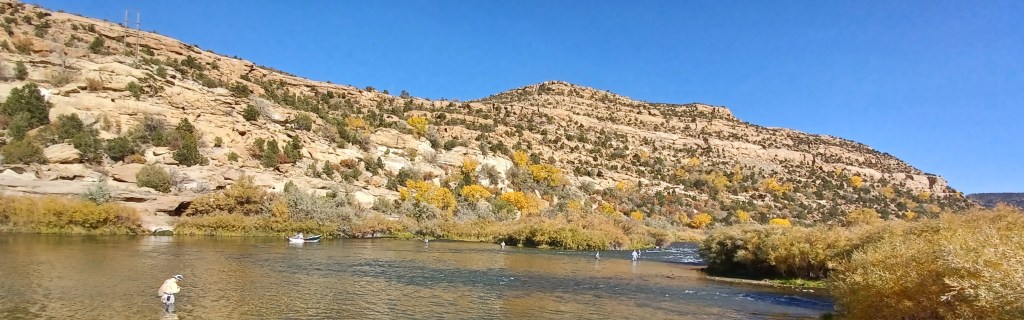
The San Juan river in New Mexico, below the Navajo Dam, is one of the more frequently mentioned tailwaters in the country when it comes to fish size and quantity. I’ve heard some people even assert that it is the best river in the whole country, if not the world! There are supposedly around 10,000 fish per mile in the 3.75 miles of what they call “the Quality Water”.
I think I may have first heard of the San Juan back in Colorado in 2016 when I was fishing the South Platte in Eleven Mile canyon. That’s also a tailwater that is known for highly educated fish that require tiny flies to tempt. I recall standing there in a shallow riffle and watching as a whole school of trout gathered in the ten feet below me to eat the bugs that my feet were dislodging. They seem to know that they are uncatchable when so close to the human in the water. When I mentioned it later in a fly shop, the response was, “Oh yeah, that’s called the San Juan Shuffle”.
Well, yesterday I experienced it again, but on the San Juan river this time. In one of the spots closest to the dam, in a stretch at the B.O.R. access, I looked down and saw what had to be a 22 inch rainbow at my feet. And he was joined by half a dozen or so of his friends and their smaller family members.

I haven’t figured out yet how to get better images from above the surface with my point and shoot Fuji, but it does OK if aimed well underwater. When I was reviewing the pictures last night, I thought one of the bigger fish had something unique to zoom in on.

Like so many of the fish in these heavily pressured rivers, he’s been caught many times. His jaw is missing a chunk, and just below his eye is brown chocolate foam post emerger, maybe a size 22…

I find myself wondering now and then about what this means for the fish. I tend to come down on the side of, “they are just fish, they are a resource”. Humans have relied on fish as a resource for sustenance and even fertilizer for tens of thousands of years. Who am I to anthropomorphize them and have sympathy for their possible suffering?
But still, I can’t overlook the scarring that mars the beauty of the animal.
Later, in a stretch of water a bit closer to the Cable Hole, I hooked a substantial fish on a small fly I’d tied to approximate something I’d found online called a Yong OJ. Andy Kim is a well known San Juan specialist, and this fly is tied to resemble either an egg or a small scud.
After a pretty short fight, two or three minutes tops, I had the fish in the net and my size 22 pink fly was in the corner of its jaw. Which was plenty scarred from previous battles.
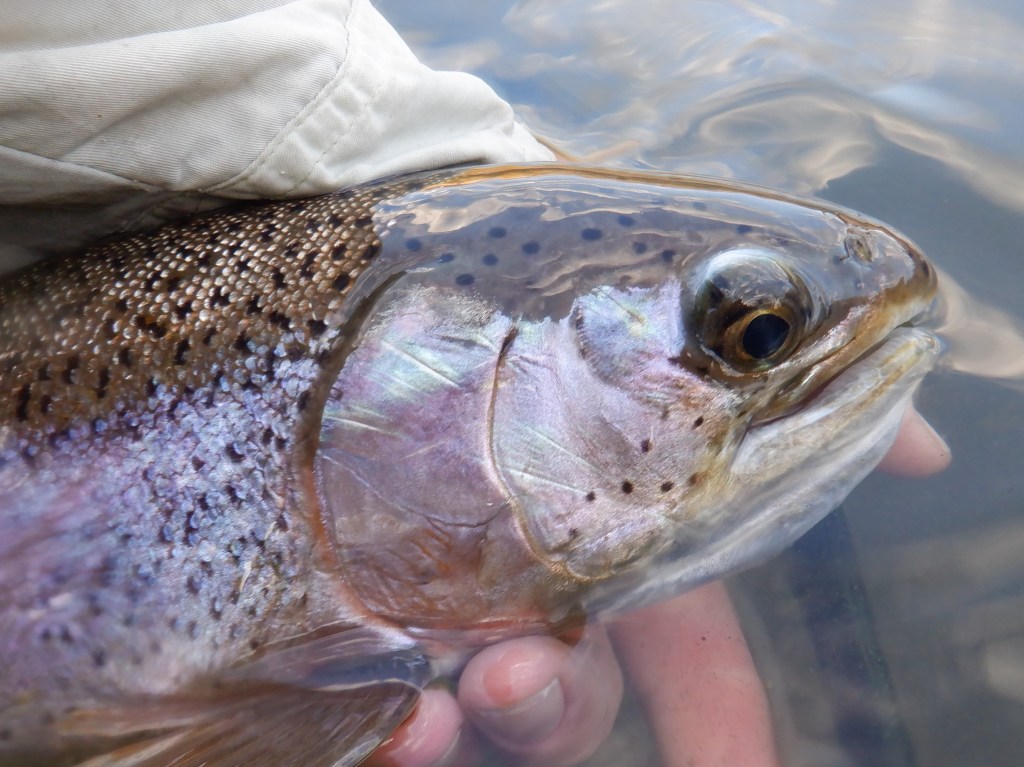
I’ve been on the river for a week and overall, my experience has been sorta ho-hum. I want to succeed at the challenge of catching big fish on tiny flies, but so far, this rainbow was the first sub-surface win, on the swing though, not under a yarn indicator. I’ve caught a few on top, despite this river having a poor reputation for dry fly fishing. One of the biggest hassles is that there is a ton of algae and goop in the water, and my size 24 and 26 midges keep coming back coated in slime. Another thing with a San Juan moniker I’ve learned is “the San Juan Slap”. Everyone on the river swings their rig in a big circle and slaps it on the water to fling the crud off their flies. It’s a pretty annoying background noise.
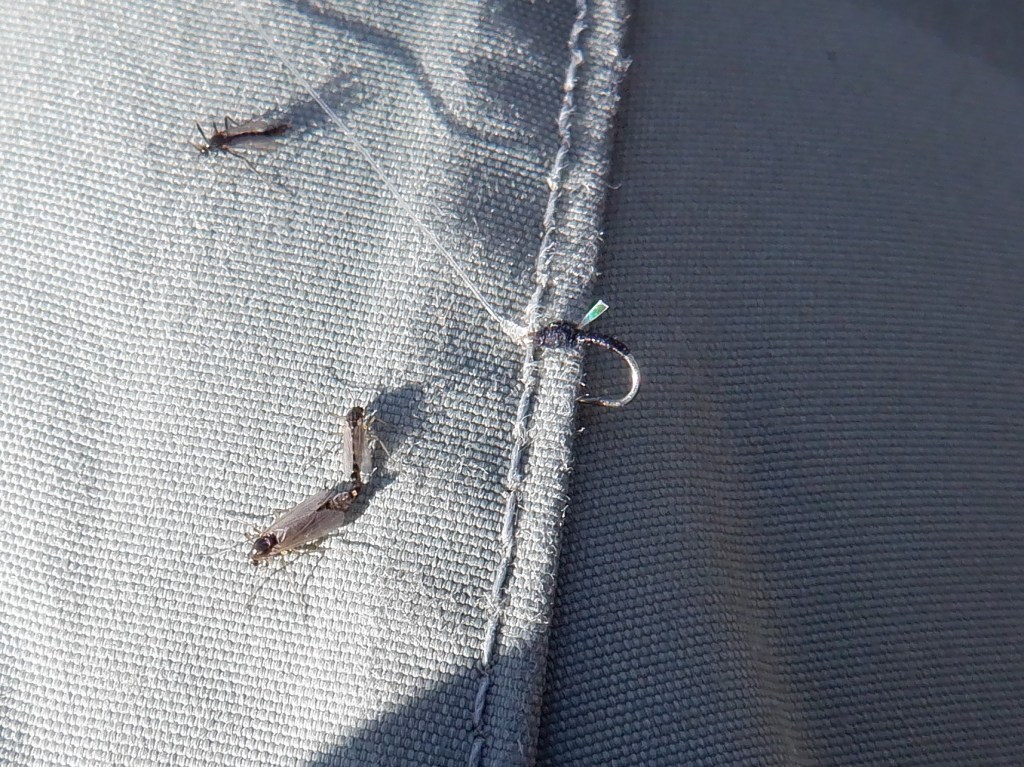
I’ve got until Sunday to figure out the nymphing game, which is good timing. The Indian Summer that’s been hanging around is supposed to vanish into 27 degree nights here. I’ll head further south to find a warmer body of water to stand in. Wish me luck!
 TRAVELINGWITHTOOLS
Leave a comment